Saturday Open Haus
A full-stack event platform for a recurring house-music brunch that doubles as an agent-attraction funnel — RSVP intake, Turnstile-gated admin approval, QR door check-in, a…
- 336
- automated tests gating every deploy
Problem
Licensed real-estate agents don't respond well to direct recruiting pitches, and a recurring event with any visible brokerage tie reads as a sales funnel the moment it's recognized as one. The challenge was building a genuinely appealing recurring social event — a curated house-music brunch — that could also identify which attendees were actually engaged and worth a real recruiting conversation. The public-facing brand couldn't carry any trace of the backing brokerage, recruiting language, or downline structure that would break the format the instant a guest noticed it.
The positioning had to read as "Soho House meets real estate": curated and relationship-first, explicitly not a chamber mixer, brokerage event, or vendor lunch. The copy could never slip into pitch language ("no speakers, no games, no listing pitches"), since even one sales-page sentence on the public surface would collapse the premise for anyone who noticed it.
What was built
A full event-operations platform was built: a public landing page with RSVP intake, a Turnstile-gated admin approval workflow (approve/waitlist/decline/no-show), and a QR-code check-in flow for the door. There's also a members-only hub at /hub with magic-link login, giving approved guests an agent directory, an event "set" page (playlist/gallery), a member feed, next-event RSVP, and referral links.
Behind the public event, the admin surface computes a per-guest "warmth" score from check-in history and hub engagement to flag which agents are actively engaging and worth a follow-up conversation. That signal is never shown to guests and never persisted, only computed on demand when the admin dashboard loads.
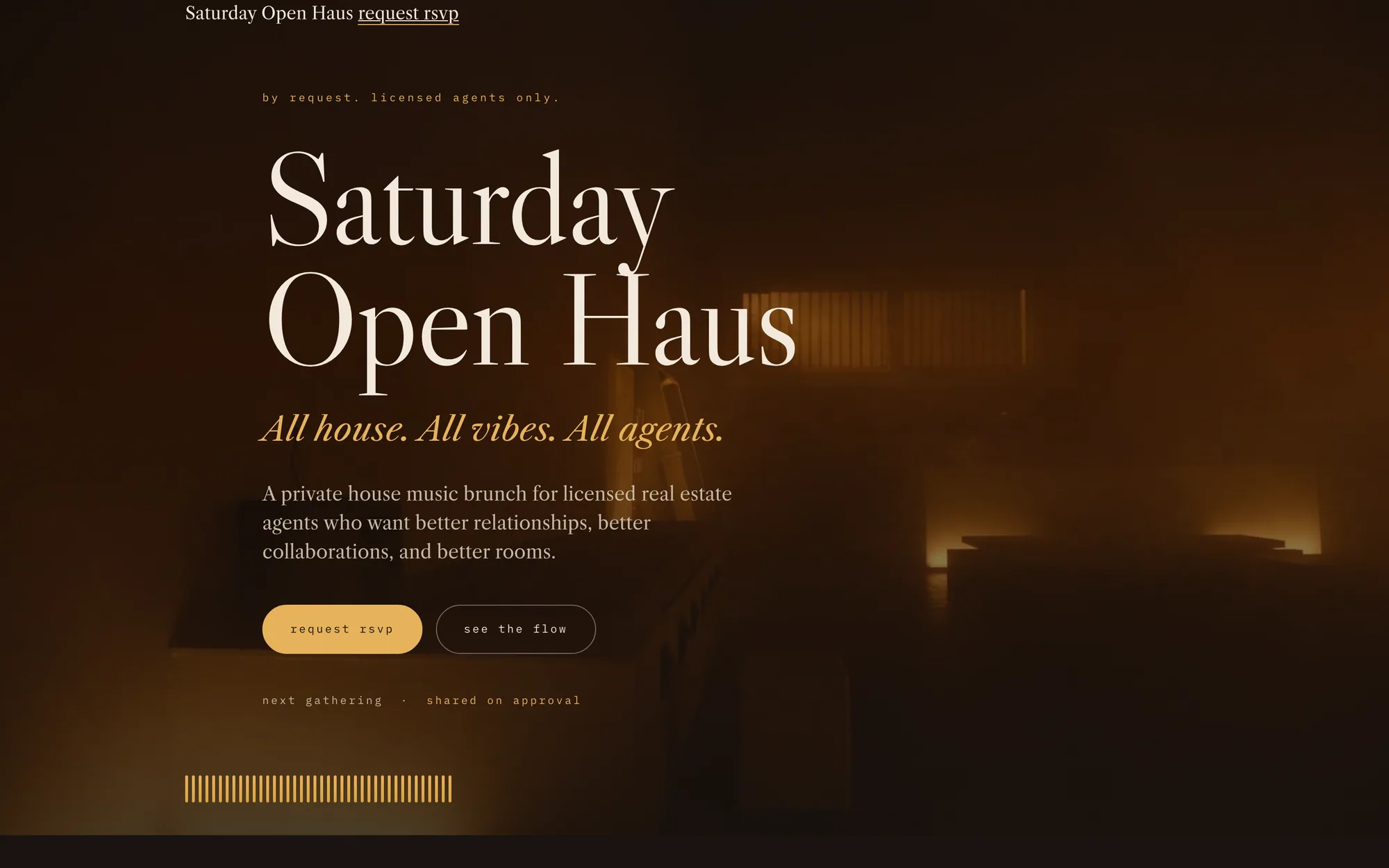
The public landing page went through a full visual reskin mid-build, from an ivory "Field Studies Flora" look to an immersive golden-hour house-party aesthetic with a video hero, audio-reactive equalizer, and parallax scroll rooms, after the original design was judged too boring. A companion Cloudflare Worker handles scheduled reminder emails since Cloudflare Pages itself has no cron.
Technical approach
The system of record is Cloudflare D1 with a frozen core schema (events/guests/sponsors). All subsequent features were added as additive migrations, not schema changes, keeping the original data contract stable across six migration waves.
Admin and check-in routes sit behind Cloudflare Access (team-gated, allowlisted email, one-time PIN); the member hub uses a separate stateless auth scheme (HMAC-signed magic-link cookies, no session table) instead of reusing the Access layer, since hub members aren't the same trust tier as admins.
The most distinctive engineering decision is an automated "cover-integrity" test (tests/cover.test.ts) that fails the build if any brokerage, recruiting, or downline-related term reaches the public-facing source or built assets. It turns a brand-safety rule that would normally rely on manual review into a CI gate, extended to cover client-side scripts as well as markup. A companion voice guard bans em/en dashes and emoji on the public surface, including catching a Unicode play-icon glyph (▶, U+25B6) that technically counts as an emoji character under Unicode's Extended_Pictographic property; it was replaced with a CSS-drawn triangle instead.
Several real infra constraints surfaced and were solved instead of avoided. Cloudflare Pages has no native cron, so a separate companion Worker runs the daily reminder job and calls back using GET instead of POST, because Pages blocks cross-site POST as CSRF protection, with a shared secret verifying both sides. AI-generated hero stills from one model silently added people/faces into frames unless the prompt explicitly excluded them, requiring a regeneration pass. Local Playwright screenshot capture of the animated landing page hung the MCP tooling, worked around by driving a cached Chromium instance directly with reducedMotion: 'reduce'. Every UTM parameter on an inbound RSVP link is captured and stored raw on submit instead of parsed-and-discarded, so channel attribution can be recomputed later even if the parsing logic changes.
Creative approach
Craft
The golden-hour redesign replaced an ivory pastoral aesthetic with a moody espresso-and-warm-gold palette built around a full-bleed video hero (turntable, espresso) driving an audio-reactive gold equalizer, alternating dark/light scroll "rooms" with parallax image bands, and a continuous gold waveline motif tying sections together. It was a direct response to specific creative feedback that the original look read as flat, not as an event worth attending.
The palette is a five-tone system: espresso, oat milk, charcoal, soft white, warm gold. It's paired with a serif/mono type stack — Libre Caslon Display for headings and large numbers, Libre Caslon Text for body copy, IBM Plex Mono for labels and buttons. Email templates approximate that stack with web-safe fallbacks, since custom fonts don't render in most inboxes.
Event-format language carries the same craft discipline as the visuals. The five activity zones are named "connection pockets" (Coffee Haus, Collab Nook, Reel Booth, Partner Haus, QR Exchange Bar), not "vendor zones" or "stations." The dress code is framed as "all house — come camera-ready," not a generic dress-code line. The copy voice stays as considered as the palette, down to the smallest label.
Reframe
The structural insight is separating the disguise from the mechanism: the entire attraction-intelligence layer (warmth scoring, guest-type flags, admin notes) lives exclusively on the admin side and is computed, never stored as a labeled signal a guest could stumble on. The public event doesn't need to pretend not to be a funnel, because the parts that would give it away architecturally never touch the public surface at all.
Making cover-integrity an automated build gate, instead of a style guideline, converts a judgment call — "does this copy sound too corporate?" — into a deterministic pass/fail the same way a type error would be. That matters because a single leaked term on a public page would collapse the entire premise of the event.
Process and what failed
Several planned features were explicitly cut once real requirements clarified: a CRM sync (Follow Up Boss) was ruled out of scope since D1 is the system of record and no downstream sync was needed. Twilio SMS and Apple Wallet pass support were both built toward and then dropped as unnecessary channels once email proved sufficient.
The "play the set" audio feature shipped visual-only at launch. The equalizer animates on an idle loop by default. The actual audio player is wired but hidden behind a build-time environment flag, because no licensed house-music loop was available yet, and the two audio-generation tools on hand (one lacking a dedicated tool, the other TTS-only) weren't fit for a music loop. Instead of faking it or delaying the whole feature, the code shipped complete and flag-gated, ready to switch on the moment a real audio file exists.
Outcome
Live at saturdayopenhaus.com with the public RSVP-to-D1-to-Resend pipeline verified end-to-end in production, admin approval and door check-in in active use, and the member hub, cron reminder worker, and golden-hour redesign all shipped and verified live on desktop and mobile.
The test suite (336 tests, plus the cover-integrity and voice guards) runs as a pre-deploy gate. The cover-integrity and voice checks specifically block pnpm guard, and therefore block deploy, the moment a brokerage term, dash character, or emoji reaches public-facing source.
A launch-audit hardening pass closed out on 2026-08-27: member emails rethemed, a verification re-audit returning zero findings, and the monthly-cycle end-to-end suite passing 22/22. The next event's date and venue are now set in the live event row; real event photography remains the owner's outstanding step.
A September 2026 audit across five lenses raised six standing findings and drove a same-night hardening pass. A single guest approval could previously be granted past the event's guest cap, even though the bulk-approve path already enforced it; the single path now returns a 409, covered by a mutation-tested route test. The same pass replaced a hardcoded reminder-email placeholder with an admin-set field, and corrected consent copy that had promised a text opt-out channel no code implemented, so the copy now describes the email-only channel that actually exists. Click tracking was enabled on the sending domain through a dedicated tracking subdomain, with open tracking deliberately left off.
Related work
- Live2026Evolve Agentic SiteA 61-page trilingual marketing and productized-service site with its own tiered pricing engine, four live D1-backed lead endpoints, and a documented history of pricing model…
- Live2026Evolve StoresA static-site generator that builds 32 independent brand storefronts from one codebase, with build-time voice and brand-isolation gates and gated digital delivery.
- Live2026Studio + University SitesTwo sister marketing sites split off one brand family, shipped from a single monorepo with matching architecture, opposite palettes, and a home-grown Python translation…