Evolve Agentic Site
A 61-page trilingual marketing and productized-service site with its own tiered pricing engine, four live D1-backed lead endpoints, and a documented history of pricing model…
Problem
An agentic-systems consultancy needed a site that could sell a genuinely broad offer, custom platform installs, a website-as-a-service tier, and custom software builds, in three languages. It needed to do that without collapsing into a vague "we can build anything" pitch (unsellable), and without turning into a runaway pricing sheet with unreconciled numbers scattered across pages. Earlier iterations of the pricing model accumulated four separate, contradictory ladders and off-ladder prices quoted inconsistently between the services and pricing pages. One was an invented web-app pricing ladder that had no real product behind it, and existed only because "we can build anything" needed something to point to. The pricing sheet problem compounded across languages, too: a translation regeneration step could silently revert already-translated Spanish and Portuguese lines back to English whenever the underlying English copy drifted after a translation dictionary was written. A pricing fix on the English page could quietly reintroduce a stale, contradictory number on the mirrored pages if nobody diffed the output. The site needed a structural fix, not a copy edit, to stop the ladder from re-proliferating every time a new offer got added.
What was built
A static, no-build Cloudflare Pages site runs 21 English pages mirrored into Spanish and Portuguese (61 total). It covers a positioning built around owning versus renting your business infrastructure, a single reconciled pricing ladder (One Platform, Full Stack, Command, plus a separate website-hosting entry lane), and a 12-item module catalog cross-linking to the operator's own live products. Four working lead-capture flows round it out: booking, general leads, a scope estimator, and website-service intake, each writing to Cloudflare D1 and triggering Resend email, gated by Turnstile. The module catalog is not aspirational copy. Each of the 12 entries names the specific system the operator actually runs it on: a client portal and CRM (Chrysalis), a task and deal tracker (Evolve Tasks), a course and member platform (Evolve University), a community (Monarch), an AI assistant (A.I. Portal), a document generator (Lamma), a storefront (32 live brand stores), records search (ParcelOS), booking and intake (this site's own forms), reporting (Chrysalis reports), and email digests (EBI briefs). A lead-magnet PDF (a self-scored AI-readiness audit) is emailed automatically on capture. A homepage funnel shared with the sister sites sits alongside the scope estimator as a secondary hero CTA: an avatar selector routing into /real-estate, /small-business, /industries, and /scope, plus a "How Evolve fits together" ecosystem module marking this property "you are here" among the four Evolve brands. The site also carries a from-scratch cinematic motion layer (letterbox reveal, cursor-reactive spotlight, scroll-triggered section reveals) applied additively on top of a locked visual system.
Technical approach
The stack mirrors the sister-brand pattern deliberately: static HTML/CSS/JS served from public/, Cloudflare Pages Functions in functions/api/ (book.ts, lead.ts, scope.ts, website.ts) each backed by its own D1 table, Resend for transactional email, Turnstile for spam gating, and a Python translation harness (tools/translate.py) regenerating the ES/PT trees from per-page dictionaries. The pricing architecture is the most engineering-adjacent part of the product. Pricing went through multiple full revamps documented in-repo as dated, commit-referenced changelog entries instead of being silently overwritten. First came a pivot from hourly consulting to tiered platform installs, then a full ladder consolidation from roughly 30 public price points down to 12. Care Plans folded into monthly tiers, a $500 roadmap-session product was removed, and a support-runway mechanic was eliminated in favor of continuous support from day one. A capacity pill ("N of M engagement slots open") that self-computed from a JS constant was removed entirely site-wide (18 instances, ~56 lines of JS) once the operator had no active clients to justify a scarcity claim. The explicit principle: every other claim on the site had to survive a prospect asking about it. A cross-language translation bug is documented as a recurring gotcha: tools/translations/*.py inserts that check for key presence across the whole file instead of within each language's block silently skip the second language's insert. That caused English to leak onto Portuguese pages twice before the check was fixed to be scoped per-language-block. A separate incident chased a reported 1.9:1 contrast failure on large display headings through multiple rounds of CSS A/B testing (removing font-variation-settings axes, changing weights). The team eventually concluded the actual cause was webfont-load nondeterminism in headless Chromium screenshots, not a real CSS defect, and reverted all the unverified "fixes." The page documents this explicitly as a lesson that headless-browser pixel measurements in the upper viewport are unreliable and real-browser measurement is required. The cinematic motion layer (cinema.js) is scoped defensively. The hidden state for scroll-reveal sections only applies inside a body.cn-armed class added after the IntersectionObserver is already running, specifically so a JS exception thrown before the observer initializes leaves content visible instead of permanently hidden. That's a direct fix for an earlier failure mode where the hidden class was applied unconditionally before the observer existed. Cloudflare Pages deploy propagation is documented as uneven per-URL (10-60 second lag, not edge caching, confirmed via cache-control and cf-cache-status headers), which produces false "stale" readings on verification sweeps run immediately after a green CI deploy.
Creative approach
Craft
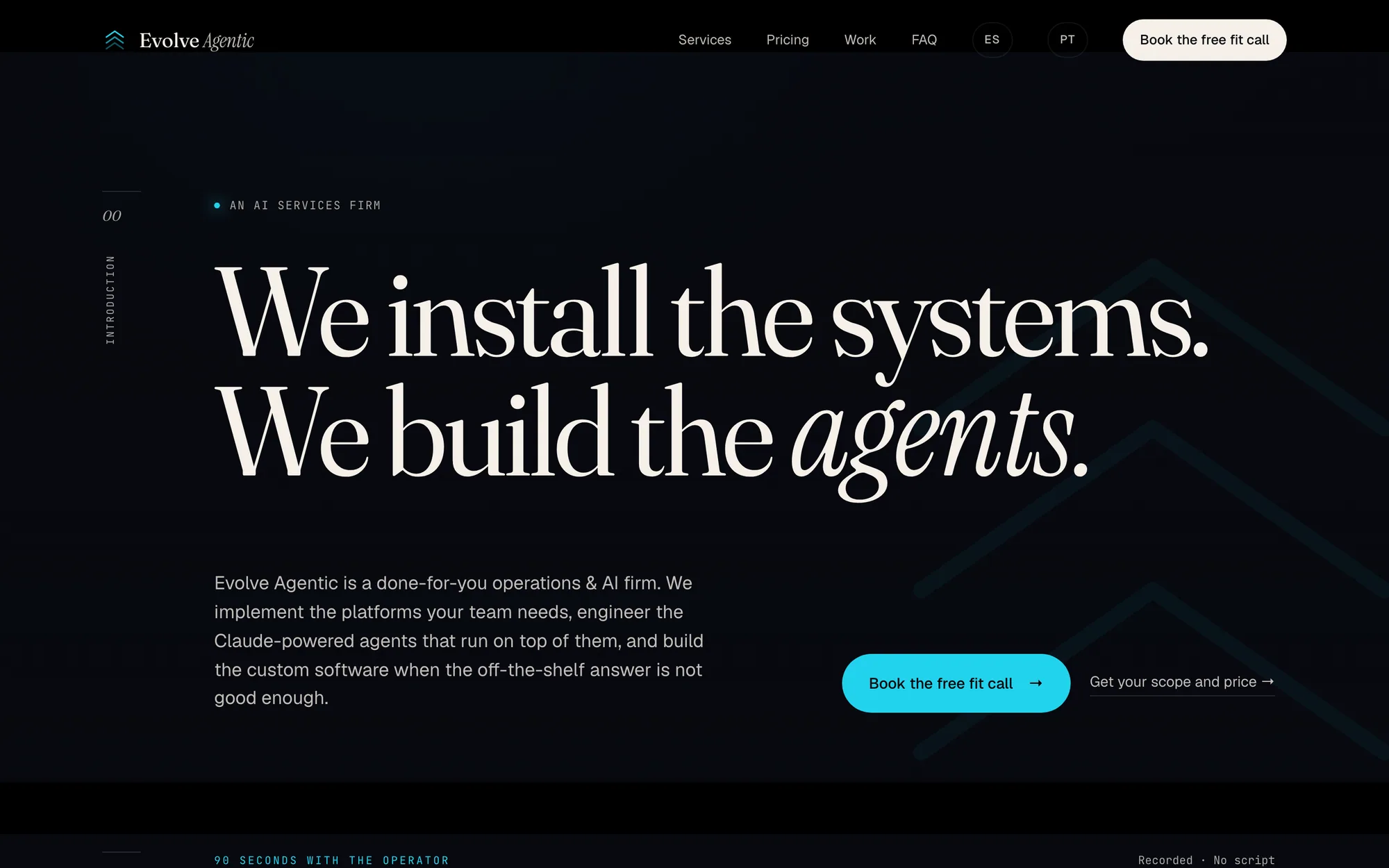
The visual identity is a near-black #07090f background with cyan (#22d3ee) as the primary accent, violet-soft and orange as secondary/tertiary accents, Fraunces for display type, Instrument Serif italic reserved specifically for emphasized closing words in headlines (mirroring the sister sites' pattern but on a technical, engineering-forward palette instead of gold or lime), Geist for body copy, and JetBrains Mono for metadata and footnotes to signal technical competence without reading as literal code. A three-opacity nested-chevron logo motif is treated as immutable brand geometry. The cinematic layer (letterbox bars, a cursor-reactive spotlight lerped toward pointer position at a fixed easing factor, masked scroll reveals) is explicitly scoped as additive atmosphere only for this site. The sister Studio site, by contrast, was designated the site with the widest creative license for the same motion system.
Reframe
The core reframe was replacing an unsellable "we can build anything" pitch with a receipts-based argument: every product on the module catalog is something the operator actually runs for their own business (a CRM replacing Follow Up Boss, a task tracker replacing ClickUp, a course platform replacing Skool), so the sales pitch became "own your stack instead of renting it," with the proof being the operator's own infrastructure, not a hypothetical capability list. The module catalog was deliberately built with zero new price points, each module tagged to an existing pricing rung instead of getting its own line item, specifically to avoid recreating the exact ladder-proliferation problem the pricing consolidation had just fixed.
Process and what failed
Pricing model history is the clearest evidence of iteration under real constraints. An hourly-consulting model gave way to tiered installs, which accumulated into four unreconciled ladders across different pages, which then collapsed into one ladder with public price points cut roughly in half. Each change is documented with the commit hash, the date, and the explicit reasoning. That includes reversals the team flagged to itself as deliberate and not-to-be-reverted, such as a $49 advertised monthly floor that looks inconsistent with the $249 install-tier monthly until you read the distinction. A capacity-pill scarcity claim was pulled entirely once it stopped being true, treated as a genuine liability, not a copy tweak. A contrast investigation burned multiple test cycles chasing a headless-screenshot artifact before the team caught that the measurement method itself was unreliable and reverted every speculative fix, documenting the false leads explicitly so the mistake would not repeat.
Outcome
Live in production at evolveagentic.ai, 61 pages across three languages, deploying via GitHub Actions on push to main. The pricing and positioning model has been revised multiple documented times through August 2026 in direct response to real inconsistencies and operator feedback, with each revision's rationale and blast radius recorded instead of silently overwritten. The most recent recorded pass, a "pricing clarity + billing rail session," ran on 2026-08-05, one day after a close-out audit commit titled "Kill the last two pre-revamp prices found by the close-out audit." That sequence shows the team treating stale pricing as a bug to be swept for and closed out, not something left to resurface. The repo's own translation-pipeline lesson, that regenerating dictionaries can silently revert live ES/PT copy back to English if the underlying English source drifted first, is documented as a standing check (git diff public/es public/pt after every regen) instead of a one-time fix. That's evidence the team expects the failure mode to recur and built a habit around it instead of trusting the fix to hold. The hosting offer has since become a productized website-as-a-service page at evolveagentic.ai/websites: three tiers priced as a setup fee plus monthly ($0 and $49, $299 and $99, $799 and $199, with annual prepay worth two months free), stated identically in the page copy and in its own OfferCatalog structured data. Fulfillment for the productized offers (installs, website hosting, custom builds) runs manually off-repo; billing is manual Stripe.
Related work
- Live2026Studio + University SitesTwo sister marketing sites split off one brand family, shipped from a single monorepo with matching architecture, opposite palettes, and a home-grown Python translation…
- Live2026Evolve Estates SiteA single hand-edited HTML file running a full multilingual real estate brokerage site — AI chat, IDX search, buyer tools, and an 11-language i18n layer, with zero build step.
- Live2026Evolve With AIA courtroom-themed landing page for a satirical AI-operator show, with a self-generating lead-magnet PDF pipeline, an email-gated toolkit, and an evidence-discipline standard…