Life, Love & (Ph)uckery
Content-ops system and pre-launch site for an independent married-couple podcast — a production pipeline that turns one recorded episode into a full week of platform-native…
Problem
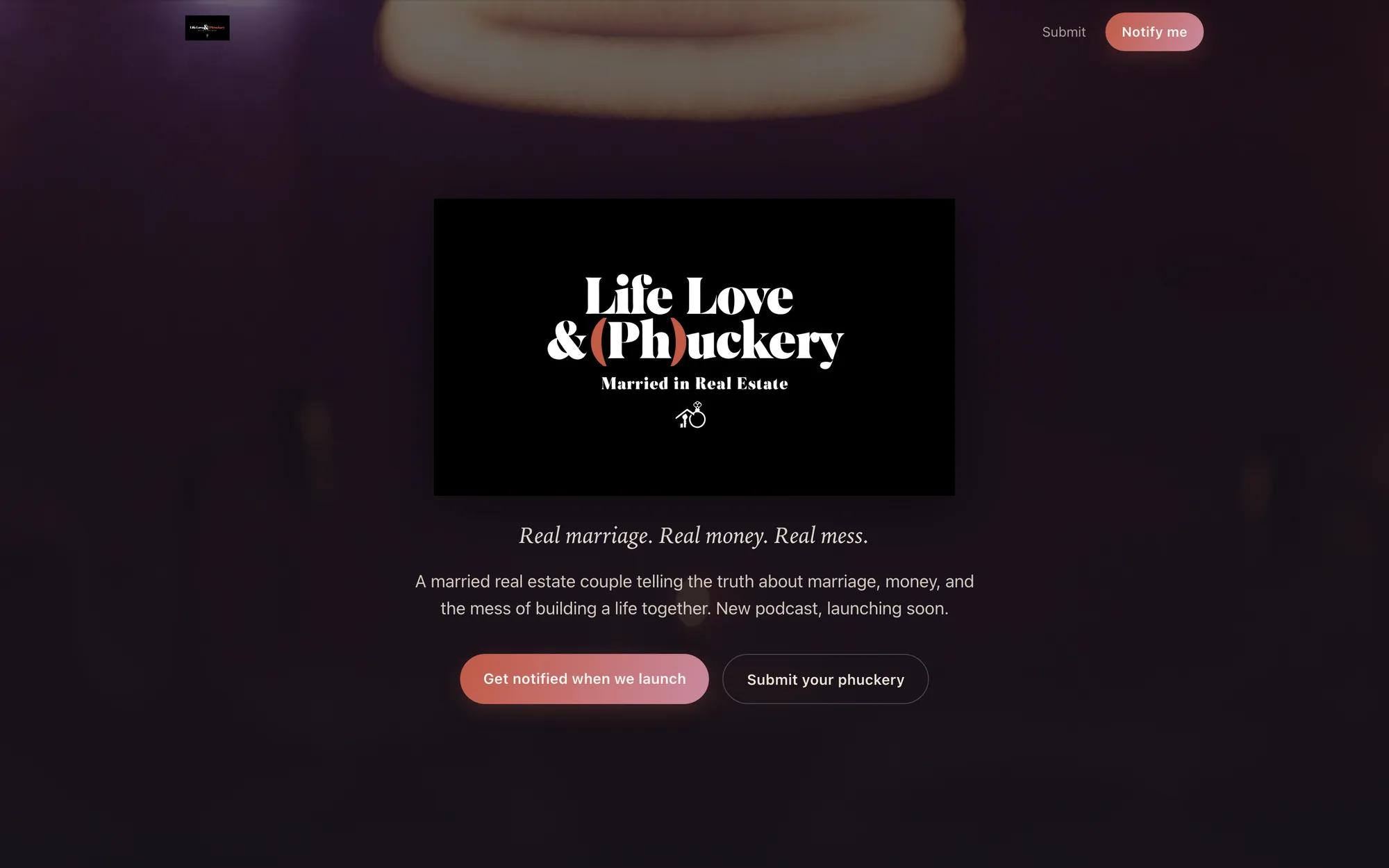
Victor and Alexis Diaz wanted to launch a podcast about marriage, money, business, parenting, faith, and building a life and real-estate company together. The show sits at the intersection of relationship, business, and family content instead of fitting cleanly into any one of those existing genres. That creates two immediate risks. One is burning out on a content treadmill: one recording becoming one video and nothing else. The other is accidentally sharing something that shouldn't be public, because there was no consistent boundary check before hitting record. The show's stylized name, "(Ph)uckery," also collides directly with YouTube's advertiser-friendly content policy on titles, thumbnails, descriptions, and tags. That needed a standing public-vs-internal naming rule instead of a per-episode argument about how far the raw brand voice could go on a monetized platform.
What was built
A content-ops repo is brand ops only, not an app. It scaffolds each new episode into a folder with pre-filled notes, description, and thumbnail-concept files. It carries the full brand brief — voice, five content pillars, structure — as an always-loaded document, so any planning session starts from the same rules. And it defines a repeatable pipeline that turns one recorded episode into 3-5 Shorts, 2-3 long-form clips, 3 Reels, 3 TikToks, one LinkedIn/Facebook post, and one email/community post. A companion pre-launch website captures launch-day email subscribers and a public "Submit Your Phuckery" listener-story form. Both write straight to an owned database instead of a third-party tool, with a confirmation email on signup. Season 1 (12 episodes) is scaffolded with titles, thumbnail concepts, and descriptions filled in. The actual episode content (notes.md) is intentionally left blank, since that's the hosts' real material and not something to fabricate.
Technical approach
The content-ops repo is deliberately not a web app. It's a git repo of markdown, shell scripts, and prompt templates. CLAUDE.md loads automatically and gives Claude Code a consistent brand context every session. A scaffold script (new-episode.sh) creates a standard episode folder structure with the boundary-check question already embedded in the notes template. The pre-launch site is a small Cloudflare Pages + Functions + D1 stack. Two POST endpoints (/api/subscribe, /api/submit) write directly to D1 tables for subscribers and listener submissions, with Resend wired for a launch confirmation email once domain verification completes. A concrete infra gotcha surfaced and got documented instead of silently worked around. The Cloudflare API token and the OAuth Cloudflare MCP both lack DNS:Edit scope. All DNS changes for the domain had to be done manually in the Cloudflare dashboard instead of automated — worth knowing before assuming any Cloudflare workflow is fully scriptable. A second gotcha: the CF DNS API renders TXT record content wrapped in quotes, which reads as a length mismatch against what's expected but is a display artifact, not a broken record. That was verified by giving Resend verification time instead of re-issuing the record. The domain itself moved from a planned .us to the live .com mid-build; the .us was never actually put on Cloudflare. It now exists purely as a 301 redirect to the canonical .com.
Creative approach
Craft
The visual identity went through a real palette reversal. An initial harsh red/black scheme was softened to a "dusk / As Above So Below" palette. A triangle/hexagram emblem meant to represent masculine/feminine union was designed, then explicitly removed once it was recognized as reading like a Star of David — too literal and carrying unintended meaning. It was replaced by conveying the same masculine/feminine balance through warm/cool color temperature instead of a symbol. The locked identity is a black/white/red palette against a premium black studio with warm lamp lighting. It's built as two logo lockups (stacked for profile/merch, horizontal for the channel banner) plus three plate variants for banners and thumbnails, all generated as true vector so they scale without a redraw. The thumbnail system is a repeatable formula, not a one-off design per episode: big emotional text on the left half, Victor and Alexis face cutouts on the right, dropped onto one of the reusable plate backgrounds. That keeps the channel reading as one visual system across all twelve Season 1 episodes, instead of drifting thumbnail to thumbnail. The set itself follows a moodboard brief — two chairs, visible mics, warm lamp lighting, a red accent panel — built explicitly to feel intimate and premium, not corporate.
Reframe
The operating insight is that the show's real product isn't the episode. It's the repurposing engine. Every episode is required to close with one concrete rule the hosts live by now. That closing rule generates the Shorts hooks, clip titles, and quote graphics as a natural byproduct, instead of requiring a separate brainstorm pass after the fact. The second reframe separates the raw/internal title (true to the story, can be sharp) from the public YouTube title (advertiser-safe). That's a standing rule, not a per-episode judgment call, so the team never has to relitigate whether a title is "too far" each week.
Process and what failed
The brand mark deliberately keeps the stylized profanity "(Ph)uckery" for logos and internal use. The public channel name was locked to a clean "Life Love & Phuckery" spelling after recognizing the raw form would trigger YouTube's advertiser-friendly content rules across titles, thumbnails, descriptions, and tags. That decision was made once and then encoded as a hard rule, with a worked example, instead of being re-decided every episode. The privacy rule was explicitly elevated from a style preference to a hard stop. If any episode's notes or a planning conversation touches something that looks like a boundary the hosts didn't agree to share, Claude Code is instructed to flag it before drafting anything, not quietly soften and continue. This was written directly into the episode scaffold template as a mandatory question ("what part of this story are we not sharing?") instead of being left as a verbal understanding.
Outcome
The pre-launch site is live at lifeloveandphuckery.com with a working subscriber-capture and listener-submission pipeline into owned D1 storage, and confirmation emails verified as delivering. The content-ops repo has a full Season 1 (12 episodes) scaffolded with titles, thumbnails, and descriptions ready, plus 75 standing Shorts hooks and 63 posts pre-drafted across the content banks. As of the last recorded handoff, the show itself had not yet recorded or launched. No trailer video, no YouTube channel, no social handles live, and host photography still a placeholder — so this is accurately a pre-launch build, not a running show.
Related work
- Internal2026Diaz Family ReactsA family YouTube reaction channel built end-to-end from a single planning zip to a live channel-hub site, a scheduled 113-item content calendar, and a kid-safety framework that…
- Live2026Charles CoveA 27-page independent community hub for a Florida neighborhood, self-maintaining via two scheduled AI jobs that fetch official sources and keep events, news, and amenity status…
- Live2026Evolve Agentic SiteA 61-page trilingual marketing and productized-service site with its own tiered pricing engine, four live D1-backed lead endpoints, and a documented history of pricing model…